
Yeastar P-Series
Yeastar P-Series: which edition fits which building
The P-Series is one phone system sold four ways: an appliance in your building, software on a server you control, a cloud instance run by a partner, or a cloud instance run by Yeastar itself. The features are largely the same. What differs is where it runs, who is accountable for it, and what happens when the internet connection does not. For the buildings we work in, that last question usually decides it.
By Dar Zuch, Yeastar Certified Expert · Last reviewed 4 November 2026
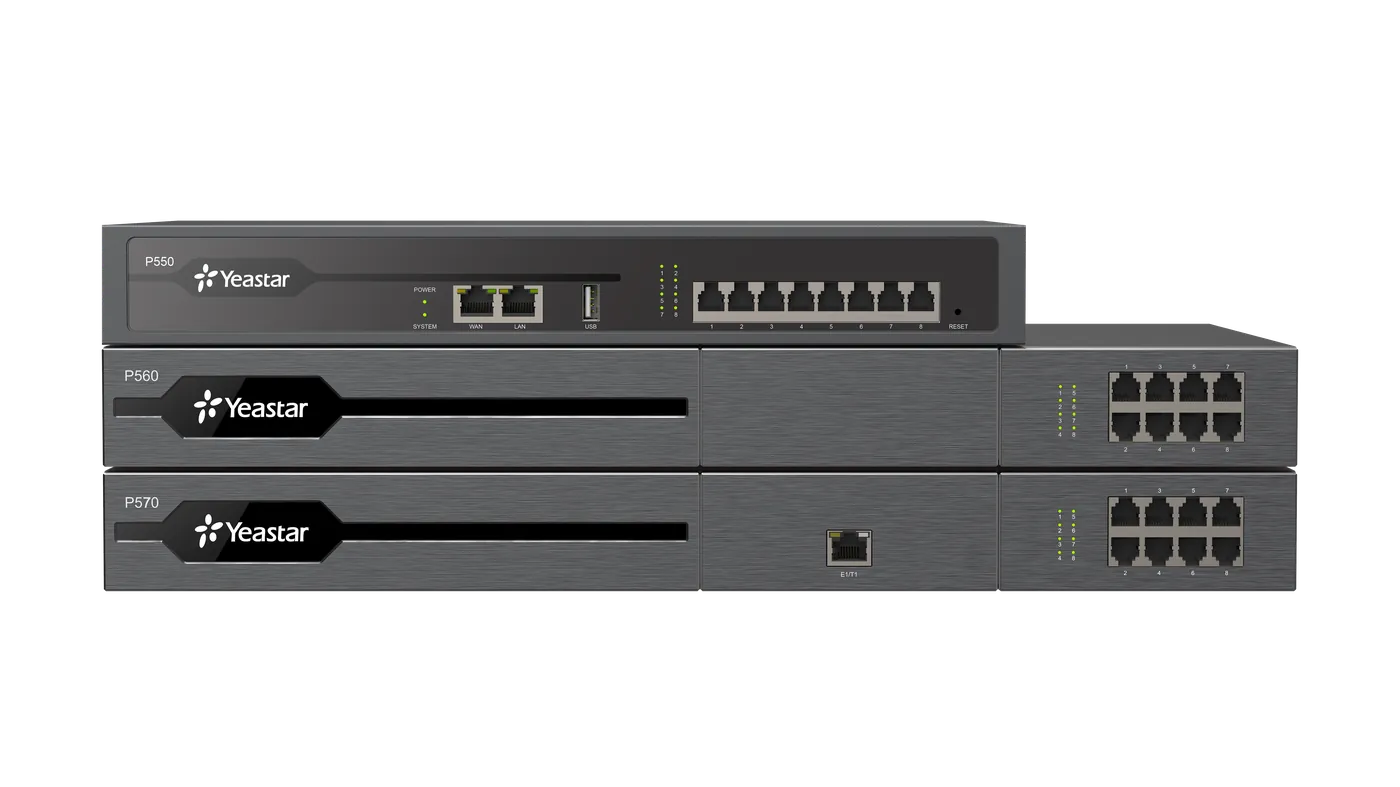
The four editions
| Edition | Where it runs | Who operates it | Plans | What it is for |
|---|---|---|---|---|
| Appliance | A P550, P560 or P570 unit in your building | You, or a partner such as North Star under an agreement | Standard, Enterprise, Ultimate | Sites where the phones must keep working inside the building when the connection is down, where analog devices are part of the system, or where the phone is a safety circuit |
| Software | A virtual machine or server you own, on site or in a data centre | You, or a partner | Enterprise, Ultimate | Larger or multi-site organisations with their own IT, who want appliance behaviour without a fixed box; the only edition with disaster recovery across two servers |
| Cloud | A partner’s own cloud platform, one instance per customer | The partner | Enterprise, Ultimate | Offices with dependable connectivity that prefer an operating cost to a capital one. North Star’s hosted service, Tribe, is built on this edition |
| Yeastar hosted | Yeastar’s own cloud | Yeastar, sold direct | — | Yeastar’s turnkey offer. Not something we resell |
How we choose
We recommend by fit, not by preference, and the fit questions are short:
- What stops working if the internet drops? In an office, the phones. In a hotel, the wake-up calls, the elevator phone’s path and the front desk. In a school, the bells and the office. If the answer includes anything safety-related, the system belongs in the building: Appliance or Software on site.
- Is there anything analog? Room phones in a hotel, a fire panel’s dialler, a door phone, a fax line in a municipal office, a pool phone. The appliance carries these on its own ports or through gateways. Cloud editions need a gateway at the site for every one of them, which adds a device that also has to stay up.
- Who looks after it? A town with an IT manager and a server room can run the Software Edition well. A sixty-room independent hotel usually wants one box, one invoice and one phone number to call. That is the appliance under a support agreement.
- What does the connection look like? Rural Alberta connectivity is better than it was and still not something to hang a life-safety circuit on. Where the link is marginal, the appliance wins outright.
- Does anyone need the AI features? The AI receptionist, call transcription and summaries run on the Cloud and Software editions only. They are not on the appliance. If they matter, that narrows the choice.
For the four kinds of building this site is about, the honest summary is: hotels, schools and care homes are appliance sites almost every time; municipalities split between appliance and Software depending on their IT capacity; small offices with good connectivity are where Tribe fits. Yeastar’s own direction is toward its cloud. We keep appliance expertise precisely because that is where our customers’ buildings still need it.
What is the same across editions
- Linkus clients: web, Windows and macOS desktop, iOS and Android, a Chrome extension and an operator panel. Staff carry their extension on a phone.
- Call handling: IVR, queues, ring groups, time conditions, call recording, voicemail to email.
- Paging and intercom: one-way paging groups, two-way intercom, scheduled announcements with custom prompts, SIP paging systems and door phones as endpoints.
- Emergency notification: when any extension dials an emergency number, named people are told by email or call, with the extension that dialled.
- Microsoft Teams: calling inside Teams without a Teams Phone licence; Entra ID user sync.
- CRM integrations: Zoho, Salesforce, HubSpot, Bitrix24, Odoo, Dynamics 365, plus an API.
- Security: SRTP and TLS, automatic and static defence rules, a global blocklist, two-factor authentication, allowed-country and dial-code restrictions, outbound call frequency limits.
- Remote management: through Yeastar Central Management, which is how we monitor, back up and service a system without a site visit.
What differs, and matters
| Capability | Appliance | Software | Cloud |
|---|---|---|---|
| Hotel management module and PMS interface | Paid add-on; P550, P560, P570 only (not P520) | Included at Enterprise and above | Included at Enterprise and above |
| Hot standby (second unit takes over) | Yes, with a second appliance | Yes, with a second server | Platform-level, by the partner |
| Disaster recovery across sites | No | Yes, with a redundancy server | Platform-level |
| Outbound call centre | No | Optional add-on | No |
| AI receptionist, transcription, summaries | No | Yes, metered | Yes, metered |
| Analog ports on the unit | Yes, by module | No (gateways) | No (gateways) |
| Works with the internet down | Internal calls, paging, analog circuits: yes | Same, if the server is on site | No |
Frequently asked questions
Is the appliance an old-fashioned choice?
It is the only edition with analog ports on the unit. For a building where the phone is a safety system, local is a feature.
Can we start on an appliance and move to the cloud later?
Yes. Yeastar publishes a migration path between editions, and the configuration carries over. The reverse is also true.
Do we have to buy Yeastar’s plan every year?
The Appliance Edition’s Standard plan is a one-time purchase with the unit. Enterprise and Ultimate, remote management, and the hotel add-on are subscriptions. We say which you need and why on the quote, not after.
Which edition is Tribe?
Tribe is North Star’s hosted service, built on the P-Series Cloud Edition and run from our platform. It is the right answer for an office; it is rarely the right answer for a hotel or a school, and we will say so.
Edition, plan and feature details from Yeastar’s P-Series product pages, checked 4 November 2026. Plan contents change; the quote is the document that governs.
Start with a Telephony Health Check
A fixed-fee review of what you have, what 911 does, whether the life-safety circuits work, and where the money leaks. $1,500 for a single site, $2,500 for a campus, plus GST, with a written report either way.
or call (403) 698-0700